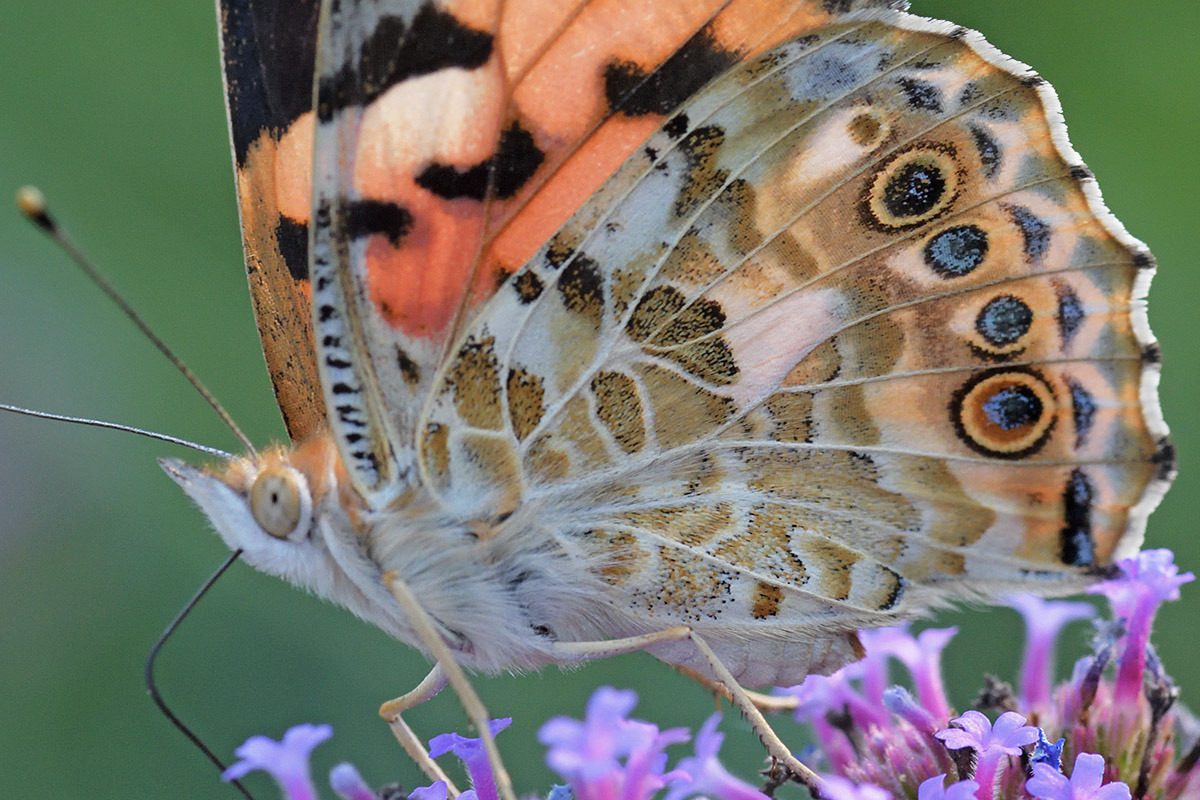
Butterfly wings are composed of thin layers of a protein called chitin. The hardened membranes are nourished and supported by tubular veins. The veins also function in oxygen exchange and, thus, in breathing. On top of these chitin layers are thousands of tiny scales, together with many hairs.
Each scale comprises of a flat plate arising from a single cell on the wing surface. There can be as many as 600 individual scales per square millimeter of wing surface.
Scales often contain pigments, which are responsible for the oranges, browns, and blacks and whites seen in butterfly wings. Greens, blue, and reds are often not created by pigments, but by the scattering of light by the microscopic structure of the scale itself.