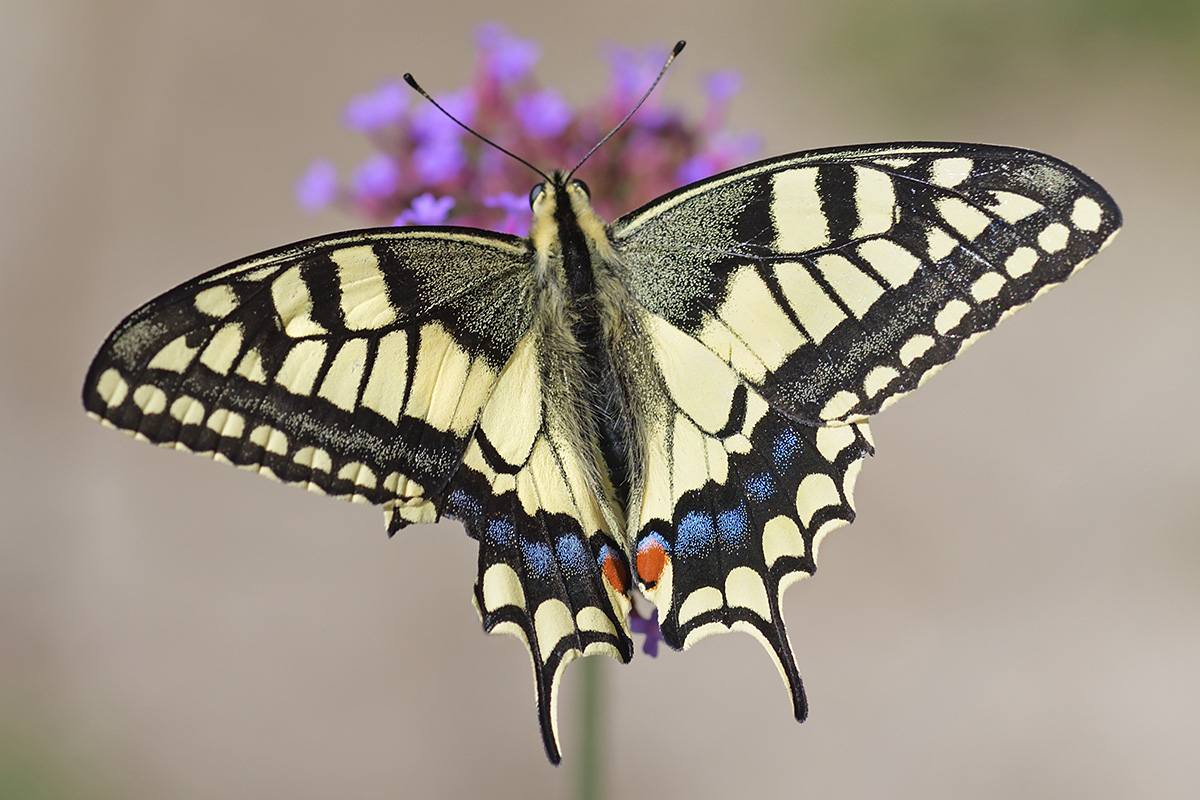
The life cycle of the swallowtail butterfly consists of four stages: the egg (5–8 days), the caterpillar (3–4 weeks), the chrysalis (2–3 weeks as a summer chrysalis or several months as a winter chrysalis), and the adult butterfly (2–3 weeks). The first generation of this beautiful butterfly appears in the spring (April/May); 1 or 2 additional generations follow in the same year.
Swallowtails prefer open landscapes. They love sunny meadows, nutrient-poor grasslands, field edges, and gardens. Adult butterflies can be spotted from April through September. Adult swallowtails do not hibernate.
After mating, the female lays her eggs individually on the leaves of host plants, preferably fennel, dill, parsley, carrots, and wild carrots. After a few days, tiny caterpillars hatch. After molting several times, they pupate on plant stems. To do this, they attach themselves to the stems with silk threads, forming a belt-like pupa. Pupae that form in late summer enter a state of winter dormancy. They are awakened by the spring sun and then emerge.
Adult swallowtails feed on the nectar of primarily purple flowers, such as thistles, clover, and lilac. They live for only 2–4 weeks. They perform what is known as “peak courtship” to find a mate. They then mate, and the cycle begins anew.